What Your LPs Actually Keep: The After-Tax Number Most Syndicators Never Model
 By Kasing Ng, CPA, former Big 4 fund auditor
Every syndicator knows the cost-seg pitch. Reclassify a big chunk of the purchase into short-life assets, elect bonus depreciation, hand your LPs a large paper loss in year one. How much moves depends on the asset. On a normal apartment building, 20% to 30% of the depreciable basis moves into short-life buckets. On a land-heavy deal like an RV or mobile-home park, the pads, the asphalt paving, the underground water and sewer mains, the utility pedestals, and the equipment can push that to 60% to 75%. The mechanism is the same on every asset class; parks just sit at the high end of it.
That part is real. Here is the part that rarely makes it into the deck.
That depreciation does not disappear. It gets recaptured when you sell, and not all of it comes back at the same rate. The 5- and 7-year personal property, the §1245 assets, recaptures at ordinary income rates, not the friendly long-term capital gains rate. The 15-year land improvements, your paving, your concrete runner pads, your utility mains, sit in between: the bonus you took on them gets pulled back too, and the straight-line piece of the real-property portion caps at 25%. So the big year-one shelter your LPs loved is, in effect, a loan from the IRS. You get the deduction early, and you pay a chunk of it back at exit.
Call it the recapture trap. Most models never show it. They run a pre-tax IRR, put it in the summary, and that is the number the LP remembers. Then the property sells, the K-1 shows up, and the tax bill is bigger than anyone expected. When an unmodeled tax hit lands at exit, LPs do not make a scene. They just quietly hesitate the next time you open Fund II. The sponsors who keep their investors coming back are the ones who put the whole picture on the page up front.
Here is what the gap looks like on an illustrative deal. Small manufactured-housing community, 100 lots, $5M, 5 year hold, financed and grown the way these deals normally are. The pre-tax LP IRR pencils out around 17.6%, a 2.07 times equity multiple. Attractive. But once you model the exit correctly, with the short-life recapture taxed at ordinary rates, the after-tax LP IRR is about 13.1% and the multiple drops to 1.75 times. That is a 4.5 point drag on the return your LPs were shown.
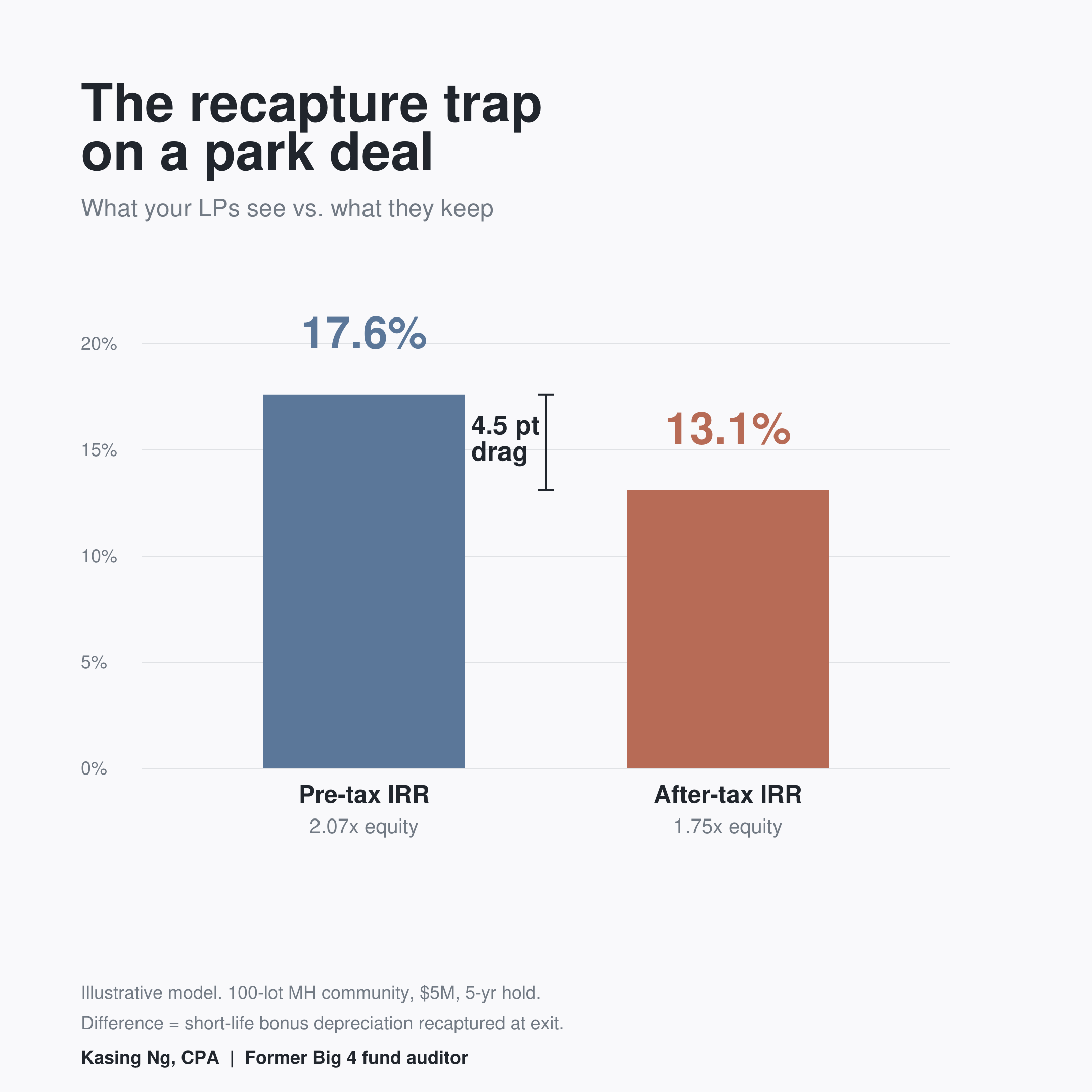
Where does the drag come from? The deal exits around $6M after 5 years of NOI growth, triggering tax on roughly $4M of combined appreciation and recaptured depreciation. Because bonus depreciation heavily burned down the short-life and site-improvement bases, a massive share of that recapture is taxed at ordinary income rates rather than friendly capital-gains rates. That is not a rounding item. It is the difference between the return in your deck and the return your investors actually keep, and it was sitting in the model the whole time.
None of that means cost seg is a bad idea. It is still one of the best tools on a real estate deal. It means the benefit and the cost belong in the same model, so nobody is surprised. And once you can see the recapture, you can actually manage it. A §1031 exchange can defer the whole thing into the next property. A cash-out refinance can pull tax-free cash without triggering it. Timing the sale, or the investor's own tax situation, can change the number materially. But you cannot plan around a liability you never put on the page.
This is the read I do. I am a CPA and a former Big 4 fund auditor. I do not file returns. I model the after-tax LP outcome your preparer does not build, so the number your investors see is the number they actually keep.
I put together an illustrative sample on a fictional deal that shows exactly this: the pre-tax return next to the after-tax return with the recapture in it. If you want a copy, just reach out and I will send it over. No pitch attached, just the sample.
And if nothing else, before your next raise, ask whoever builds your model one question: does the LP return in the deck have the exit recapture in it, or not? The answer tells you a lot.
Want the after-tax read on your own deal? I run the same pre-tax vs. after-tax read shown above on your actual deal, and you can see whether the recapture changes the story before your LPs do. The modeling tool itself is free. See how it works →Free tools: After-tax estimator · Exit tax calculator · 3 questions to ask your sponsor